


Introduction
Any company that wishes to unlock growth, justify funding, and improve strategy must be able to measure B2B marketing ROI. Knowing marketing ROI enables you to evaluate B2B marketing performance, adjust campaigns, and generate steady revenue effects, regardless of whether you are a worldwide corporation or a startup marketing firm in Pune.
Organizations now have access to powerful B2B marketing analytics services and platforms that show what’s actually producing results thanks to the growing use of AI in business and performance tracking technologies. This blog will discuss key B2B marketing ROI metrics, useful tools for measuring ROI in digital marketing, and best practices for developing a data-driven reporting structure.
The Significance of B2B Marketing ROI
Fundamentally, marketing ROI measures the return on your marketing expenditures. This entails monitoring how strategic initiatives like social media, content, campaigns, and lead nurturing result in quantifiable commercial outcomes for B2B companies.
Having a solid grasp of ROI enables you to:
- Allocate funds optimally
- Boost customer engagement
- Determine the high-impact channels
- Cut down on inefficiency and waste
- Align marketing and sales goals
Pipaani highlights the significance of marketing analytics and measurement as part of a comprehensive digital marketing strategy as a digital growth partner for startups.
Important B2B Marketing ROI Measures to Monitor
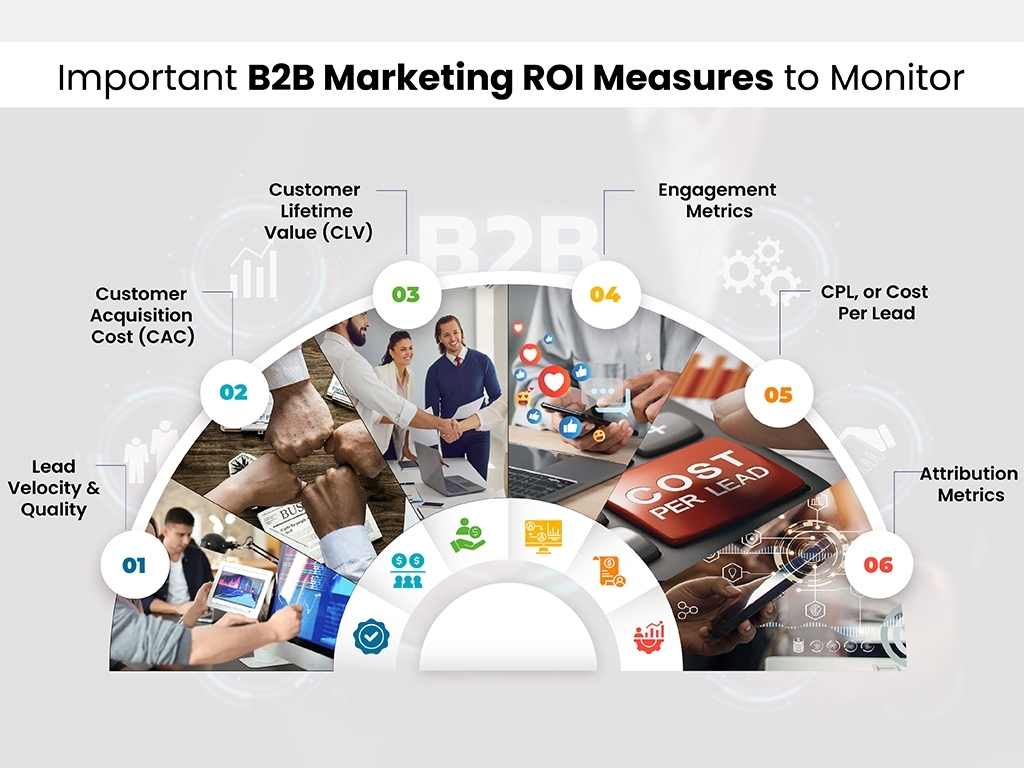
Businesses need to set up useful KPIs in order to assess B2B marketing performance. The best KPIs for B2B marketing that shed light on ROI are as follows:
1. Lead Velocity and Quality
Monitoring B2B leads and conversions enables you to comprehend not just the volume of leads but also the speed and efficiency with which they progress through the funnel. Among the important indications are:
- Marketing‑qualified leads (MQLs)
- Sales‑qualified leads (SQLs)
- Lead conversion rate
These measurements reveal whether your investments draw in the proper prospects and are incorporated into your B2B marketing ROI calculation.
2. Customer Acquisition Cost (CAC)
CAC calculates the overall cost of bringing in a new client through marketing. This covers technology subscriptions, agency expenses, content creation, and advertising expenditures. In digital marketing, lowering CAC without sacrificing quality is a reliable sign of a great ROI in digital marketing.
3. Customer Lifetime Value (CLV)
The total revenue that a client is anticipated to produce throughout the course of the relationship is measured by CLV. Making sustainable investment selections is aided by comparing CLV with CAC, which offers insight into long-term value.
4. Engagement Metrics
Key intermediate measures of campaign relevancy include engagement metrics such as time on page, bounce rate, and click-through rate (CTR). These contribute to the knowledge of B2B campaign performance and show whether audiences are engaging with your material in a meaningful way.
5. CPL, or Cost Per Lead
CPL calculates the cost of acquiring a single lead. You can identify areas where you are overspending or underperforming by monitoring this metric across all channels.
6. Attribution Metrics
By giving credit to touchpoints along the buyer journey, marketing attribution enables you to determine which channels are most important for revenue and conversions. First-touch, last-touch, and multi-touch attribution are common models.
Tools for Calculating ROI in Marketing
The appropriate technology stack is necessary for accurate measurement. The following are popular tools to measure marketing ROI and performance:
Platforms for Marketing Analytics
Deep insights into user activity, conversion routes, and engagement trends are provided by tools like Google Analytics 4, Adobe Analytics, and AI-powered dashboards. These tools aid in the development of a B2B marketing ROI dashboard that shows development in real time.
Sales Analytics and CRM
Tracking from lead capture to closing is made possible by integrating your CRM (such as Salesforce or HubSpot) with marketing analytics, which closes the gap between marketing activity and revenue results.
Tools for Attribution
For precise B2B marketing ROI metrics, specialized attribution tools (such as Attribution and Bizible) offer sophisticated models that show channel influence on conversions and conversions to revenue.
Campaign Tools and Marketing Automation
Engagement, scoring, and tracking are automated by platforms like Marketo, Pardot, and HubSpot, which also gather performance data for ROI calculations.
Reporting Solutions and Dashboards
A unified B2B marketing ROI dashboard that facilitates quicker decision-making is created by combining data from several platforms using business intelligence tools like Power BI and Tableau.
The Best Methods for Calculating ROI in B2B Marketing
Process and discipline are just as important to effective ROI measurement as instruments.
The following best practices will help you become more capable:
1. Establish Specific Goals
Prior to starting marketing, define what success looks like. Aligning on objectives guarantees that your measurement captures what is important, whether the goal is increased leads, revenue growth, or retention.
2. Coordinate Marketing and Sales Objectives
Only when marketing KPIs are connected to revenue results can they take on significance. Establishing common KPI frameworks between the marketing and sales departments makes it easier to understand the actual effects of campaigns.
3. Monitor Metrics That Go Beyond Vanity
Although likes and impressions are important for visibility, they don’t always translate into economic results. To evaluate actual performance, concentrate on actionable B2B marketing metrics such as pipeline contribution, conversion paths, and lead quality.
4. Use Multi-Touch Attribution
Buyers engage with several touchpoints during their B2B journeys. By giving credit to every significant encounter, a multi-touch marketing attribution model enhances comprehension of what motivates conversions.
5. Make Use of a Framework for Centralized Analytics
Better insights and quicker optimization cycles are supported by a consolidated B2B marketing reporting services approach that combines campaign data, analytics, and CRM.
6. Continually Review and Improve
ROI measurement ought to be ongoing rather than done on a quarterly basis. Frequent audits facilitate early course modifications, highlight opportunities, and detect stagnation.
How a Performance Marketing Firm Can Assist
Developing an internal analytics capability is difficult for many companies, particularly startups and small organizations. Joining forces with a ROI-driven digital marketing firm or performance marketing agency like Pipaani can offer:
- Professional assistance from a social media marketing agency
- Advanced B2B marketing analytics services
- Design and implementation of strategic campaigns
- Complete measurement and optimization
- Tailored digital marketing services for small businesses
Pipaani’s combination of analytics, strategic insight, and content skills enables quantifiable growth across digital channels as a content creation agency in Pune and creative agency for startups in Pune.
Real-World Example: Assessing the Performance of B2B Marketing
Think about a business-to-business (B2B) company that starts a LinkedIn content series to produce leads.
This is how their measurement flow could appear:
Campaign Setup: Establish the campaign’s goals and target audience.
Tool Integration: Connect analytics platforms, tracking pixels, and CRM through tool integration.
Data collection: Track pipeline conversions, form submissions, and engagement.
Attribution Analysis: To give credit, use a multi-touch model.
Dashboard Reporting: Every week, examine a ROI dashboard for B2B marketing.
Optimization: Allocate funds to creative and high-performing channels.
This structured methodology combines investment with quantifiable business objectives and transforms unstructured activity into insight.
Final Thought
It is now essential for any company looking for scalable growth to understand how to measure B2B marketing ROI. Businesses may turn campaigns into reliable growth engines by concentrating on significant B2B marketing ROI metrics, utilizing the appropriate tools to measure marketing ROI, and adhering to accepted best practices.
A structured, data-driven approach to ROI will lead to better decisions, more customer engagement, and measurable business value, whether you’re a B2B company optimizing spend across channels, a content and design agency seeking to quantify impact, or a startup offering branding services in Pune.
Invest in the appropriate measurement framework now to transform insights into actionable outcomes.